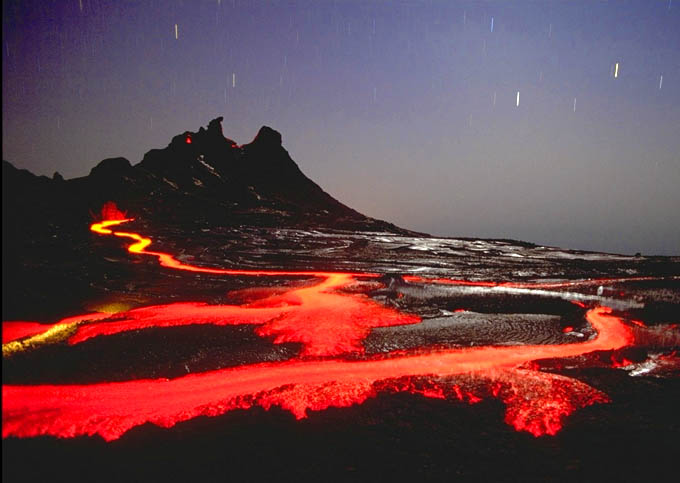
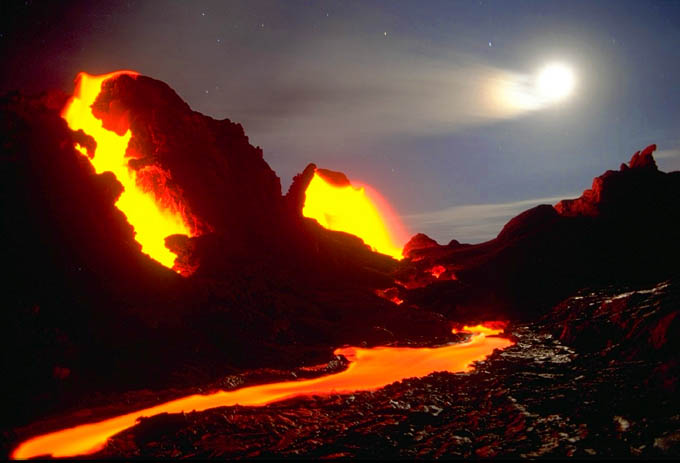
Recently I had wondered if the image is real here:

Yes, it is actually.
It is to the Ol Doinyo Lengai in Tanzania, the only active Karbonatitvulkan the earth - these volcanoes are otherwise only known from Venus. The image above cheating a bit and taken a very long exposure time (also evident in the stars). The lava lights themselves are very weak, just as visible.
But what is even Karbonatitlava? As you can imagine, it describes the lava that has a particularly high proportion of Karbonatitmineralen - at least 50%. Wikipedia writes:
This lava is very fluid, is about the viscosity of water. Recently solidified lava has a dark color, which quickly becomes a light beige. the lava of this volcano reached a maximum 590 ° C, compared to other volcanoes, lava, a relatively low temperature comes, but much deeper layers of the Earth's interior.
find a detailed text to the volcano at the end of this post.
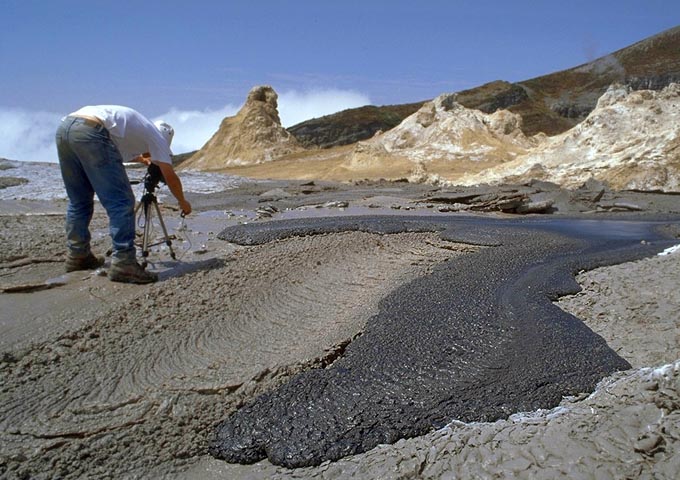
day sees the whole rather unspectacular:
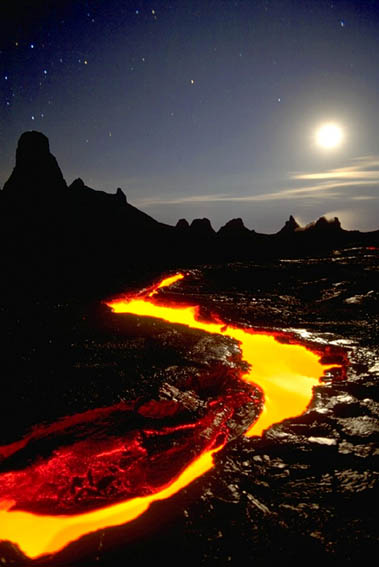
But at night, resulting scenes like from another planet:

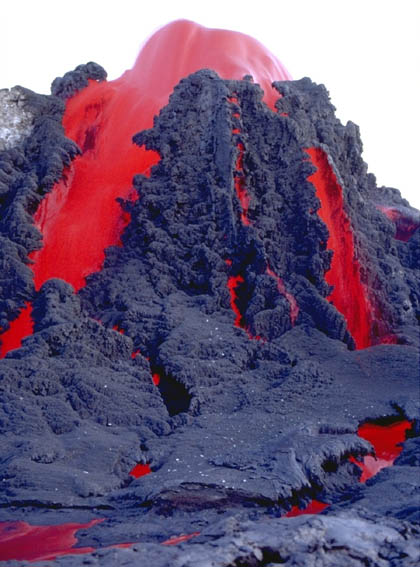
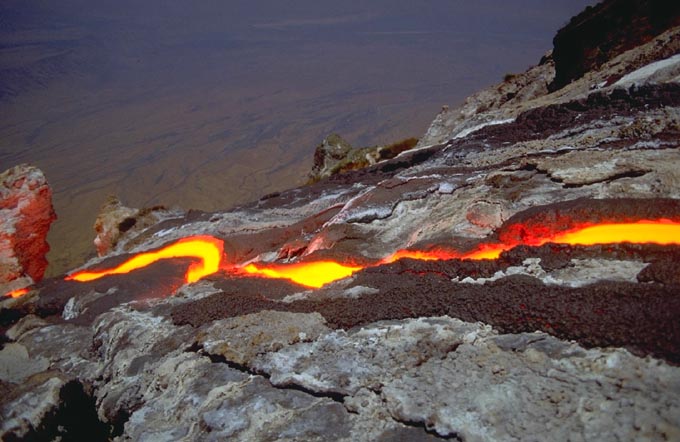
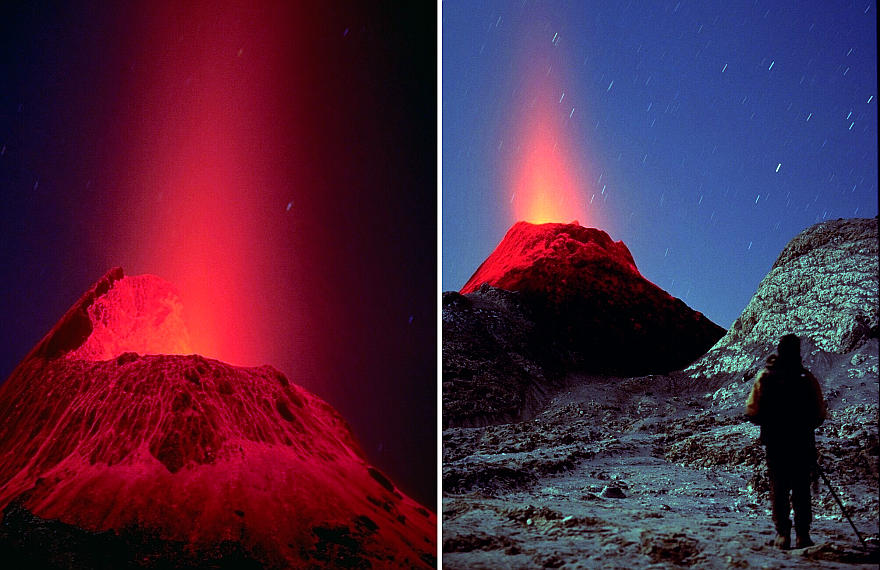

The low temperatures can get very close to go and take samples. But even this "mini-Lavatube" has a few hundred degrees.
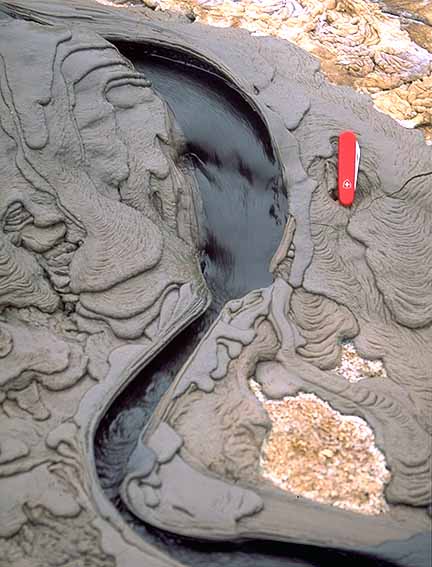
After a while, the weathered lava gray to white:

A fascinating place!
Here is a detailed text by Fred Belton :
Ol Doinyo Lengai volcano, altitude 2886 meters, is a unique and extremely fascinating volcano that towers above the East African Rift Valley in Northern Tanzania, just south of Lake Natron. It is the only volcano in the world that sometimes erupts natrocarbonatite lava, a highly fluid lava that contains almost no silicon. Natrocarbonatite lava is also much cooler than other lavas, being only about 510 degrees C compared to temperatures over ~1100 degrees C for basaltic lavas. Natrocarbonatite is the most fluid lava in the world. Lava with a low gas content can flow like a whitewater stream, and actually has a viscosity near that of water. Natrocarbonatite lava glows orange at night, but is not nearly as bright as silicon-based lavas since it is not as hot.During the day it is not incandescent; most flows look like very fluid black oil, or brown foam, depending on the gas content. In the past, some visitors to the crater believed they were seeing mud flows. Most newly solidified lava is black and contains crystals that sparkle brightly in the sun. There are also sometimes small flows known as "squeeze-ups" that are light gray when they flow and harden. Contact with moisture rapidly turns natrocarbonatite lava white because of chemical reactions that occur when the lava absorbs water. Eventually the water absorption process turns lava flows into soft brown powder. During dry weather the whitening of flows happens over a period of a few days to a couple of weeks, depending on the thickness of the flow. In rainy weather the lava surface turns white immediately. In parts of the crater that have been inactive for several months, the ground is light brown/white and so soft that one sinks into it when walking.
(Image courtesy mostly to Tom Pfeiffer, Marco Fulle, Fred Belton, Martin Rietze, Stephane Granier)
http://www.swisseduc.ch/stromboli/perm/lengai/index-de.html
Further to
http://geology.about.com/cs/volcanoes/a/aa031499.htm
http://frank.mtsu.edu/~fbelton/lengai.html
http://www.earlham.edu/~castlje/web/jessicac.htm
http://www.earlham.edu/ ~ graveti / oldoinyolengai.htm


0 comments:
Post a Comment